
Health Minister, WHO Official Agree on Epidemic Response and System Reconstruction
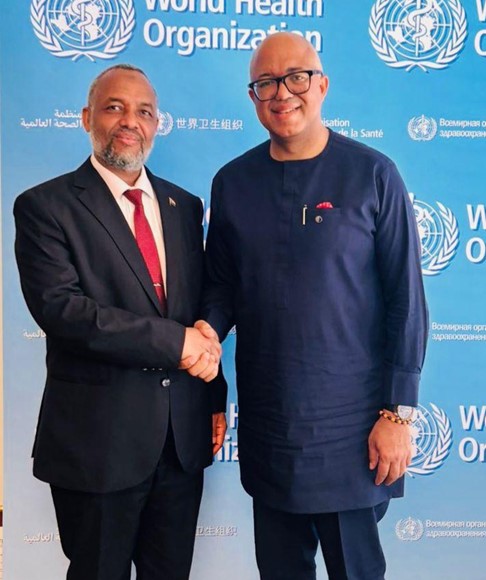
Federal Minister of Health Haitham Mohamed Ibrahim met with, Executive Director of the World Health Organization Health Emergencies Programme, Dr. Chikwe Ihekweazu in the presence of the Director of Humanitarian and Disaster Management at the programme, Dr. Altaf Musani on the sidelines of the 79th session of the World Health Assembly in Geneva. The meeting reviewed the health and epidemiological situation in Sudan and the country’s needs in the areas of epidemic response and health emergencies, including strengthening surveillance systems, laboratory support, rapid diagnostics, and rebuilding the capacities of the health system at both federal and state levels.
The Federal Health Minister expressed appreciation for the continued support provided by the World Health Organization to Sudan through its headquarters, regional office, and country office, affirming that health emergencies remain a top priority for the Sudanese government amid the impact of conditions the country has experienced in recent years. He also briefed the meeting on developments in Sudan’s health situation, noting a reduction in the scope of insecure areas and the return of large numbers of citizens, including more than three million returnees to Khartoum State, a development that has placed considerable pressure on the health system in terms of restoring services and meeting growing needs.
Minister Ibrahim stated that Sudan had faced several outbreaks in recent months, including Cholera, Malaria, Dengue Fever, and vaccine-preventable diseases. He underscored that, despite wartime conditions and access challenges in some areas, Sudan had maintained important epidemiological surveillance capacities through monitoring systems and surveillance sites across the country. He further noted that Sudan had declared itself free of cholera over the past three months, while cautioning that risks remain due to challenges related to safe water access and the prevalence of disease vectors in several areas. He stressed the importance of continued technical and financial support to address malaria, dengue fever, and other epidemic threats. The minister also reviewed Sudan’s malaria control efforts, including the launch of the National Malaria Control Campaign on April 20, 2026, and the adoption of a phased scientific approach extending over twenty years. He additionally referred to the signing of an agreement with the Gezira Scheme to support vector-control activities, particularly indoor residual spraying (IRS). He affirmed that Sudan requires a strong and coordinated response to ongoing epidemics, led jointly by the Sudanese government and the WHO, with the participation of international partners and actors on the ground, while addressing existing gaps in funding, case management, laboratory capacity, diagnostics, and medical supplies. The minister underscored that emergency response efforts must proceed in parallel with rebuilding the health system, including strengthening preparedness and surveillance capacities, establishing national functions capable of responding to epidemics, and advancing scientific, research, and training capacities at both federal and state levels. The Sudanese delegation also warned of the need for early preparedness against the risk of Ebola Virus Disease in light of the epidemiological situation in some neighboring countries, stressing the importance of proactive action before the emergence of any confirmed cases, alongside enhanced coordination with South Sudan and neighboring states.
For his part, Dr. Chikwe Ihekweazu affirmed that Sudan represents a high priority for the WHO Health Emergencies Programme and stated that the organization would continue to provide technical support while also helping mobilize the attention of partners and donors toward Sudan’s urgent health needs.
WHO representatives also indicated their readiness to work with Sudan on a comprehensive review of public health risks and to identify capacities and gaps in laboratories, surveillance, field epidemiology training, and rapid diagnostics, in addition to supporting responses to malaria and cholera and strengthening the broader health system.
Dr. Ihekweazu further announced plans for a high-level visit to Sudan in the coming period, in coordination with the WHO office in Sudan and relevant authorities, to assess the health situation directly and determine support priorities.
The meeting concluded with an agreement to maintain coordination between the Federal Ministry of Health and the WHO to support responses to ongoing epidemics, strengthen preparedness for potential outbreaks, and rebuild the capacities of Sudan’s health system to make it more resilient in the face of health emergencies.